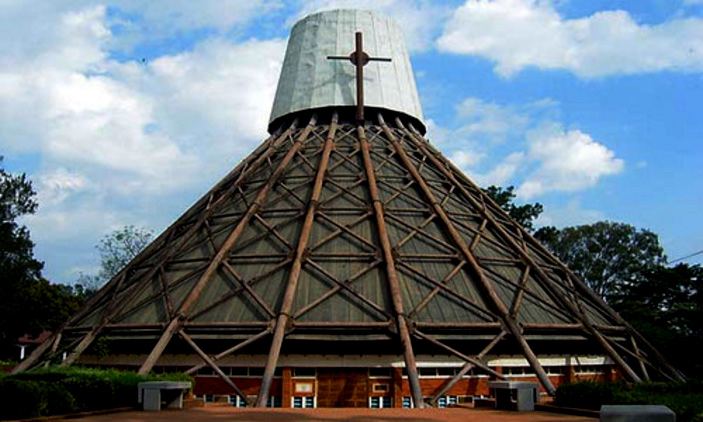
On the eastern outskirts of Kampala, along a tree-lined road that pilgrims have walked for over a century, lies one of the most sacred Christian sites in all of Africa. The Namugongo Martyrs Shrine commemorates one of the most extraordinary acts of religious courage in human history — the execution of 45 young men, pages and servants of the royal court of Buganda, who chose death over the renunciation of their Christian faith in the year 1886.
These young men — 22 of them Roman Catholic, 23 Anglican — were burned alive, beheaded, or otherwise put to death on the orders of Kabaka Mwanga II, the ruler of the Buganda Kingdom. Their ages ranged from approximately 14 to 30 years. Their crime, in the eyes of the Kabaka, was their refusal to abandon the new faith they had embraced and their resistance to his personal demands. In the eyes of the world, they became martyrs — witnesses to a faith so deeply held that no earthly power could extinguish it.
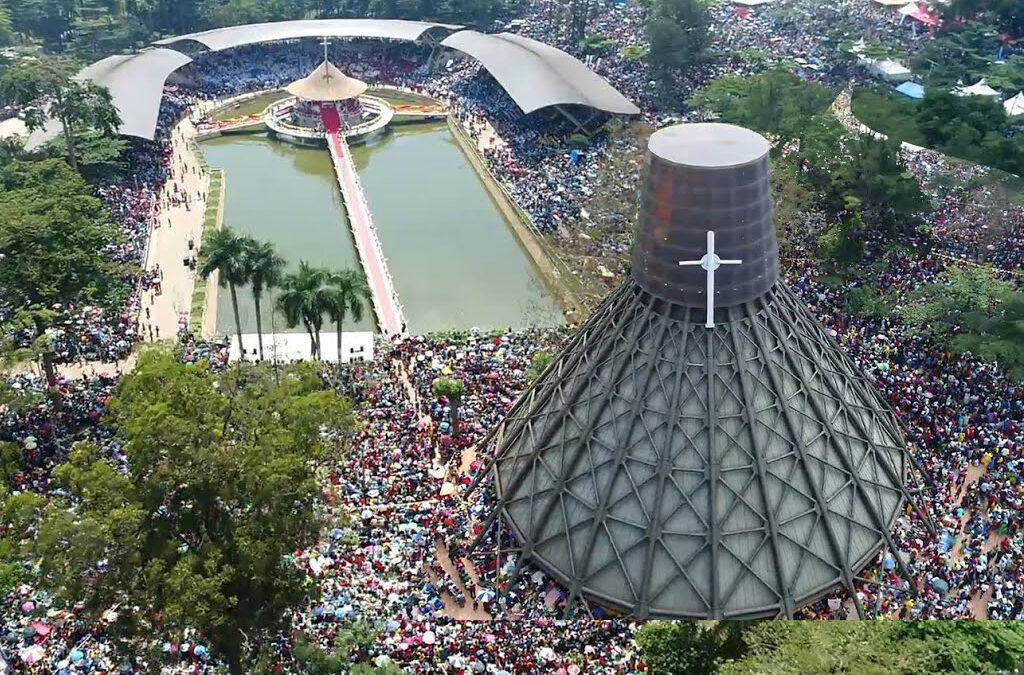
Today, Namugongo draws over three million pilgrims annually, making it one of the largest pilgrimage gatherings in the world. On 3rd June each year — the Feast Day of the Uganda Martyrs — pilgrims arrive on foot from across Uganda, East Africa, and beyond, many having walked hundreds of kilometres to honour those who died here. The site comprises two distinct shrines: the Roman Catholic Shrine, dominated by a magnificent modern basilica, and the Anglican Shrine, built on the very spot where the martyrs were burned. Together they form a sacred landscape of memory, faith, and reconciliation that is without equal on the African continent.
Historical Background: The Buganda Court & the Coming of Christianity
The Kingdom of Buganda in the 19th Century
To understand the Namugongo martyrdom, one must understand the world in which it took place. The Buganda Kingdom in the latter half of the 19th century was one of the most sophisticated and powerful states in sub-Saharan Africa. Under Kabaka Mutesa I — the father of Mwanga II — Buganda had become a cosmopolitan royal court, open to Arab traders, Islamic influence, and, from the 1870s onwards, European Christian missionaries.
Mutesa I was a shrewd and calculating ruler who used the competing influences of Islam, Catholicism, and Anglicanism as political tools, playing each faction against the others to preserve Buganda’s independence. He invited both the White Fathers (Roman Catholic missionaries) and the Church Missionary Society (Anglican) to establish missions in his kingdom, creating a complex religious landscape at his court.
The Arrival of Christianity and the Pages of the Royal Court
The royal pages — young men of noble birth who served at the Kabaka’s palace — were among the most enthusiastic early converts to Christianity. These young men, serving at the very centre of Buganda’s political and social life, encountered the missionaries at the palace and were drawn to the Christian message with remarkable depth and sincerity. They read the scriptures, attended catechism classes, and embraced the moral framework of their new faith with a thoroughness that would ultimately cost them their lives.
The pages occupied a unique social position: they were educated, politically connected, and deeply embedded in the structures of royal power. Their conversion was therefore not merely a personal spiritual matter but a political one, with significant implications for the structure of authority and loyalty at the Buganda court.
Kabaka Mwanga II and the Gathering Storm
When Kabaka Mutesa I died in 1884, he was succeeded by his son Mwanga II, a young man of approximately 16 years who inherited a kingdom increasingly under pressure from external forces. British and German colonial ambitions were closing in on East Africa. Arab traders were pressing their political and economic interests. Protestant and Catholic missionaries were competing vigorously for converts and influence.
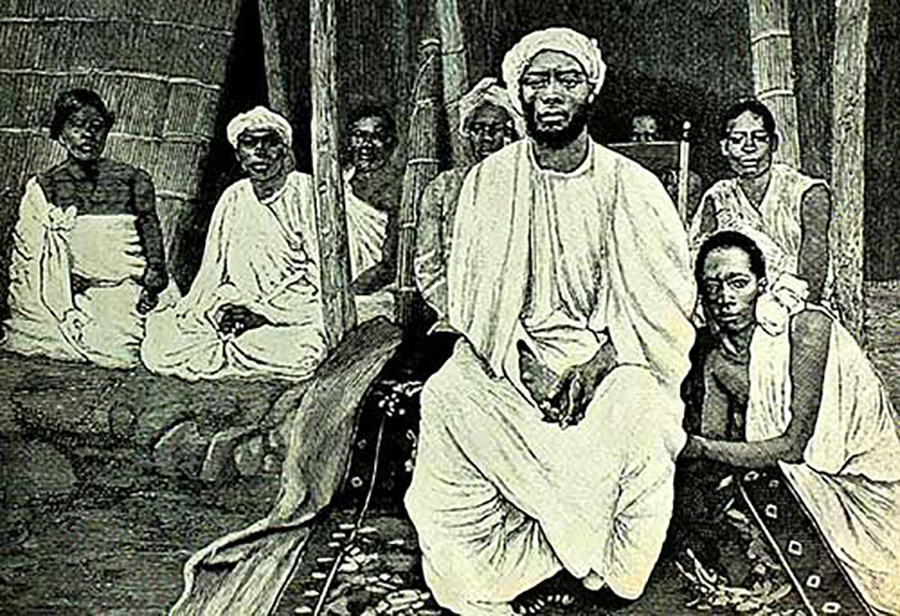 Mwanga was deeply suspicious of the missionaries and their growing influence over his pages. He feared that the loyalty his pages owed to their Christian faith — and indirectly to the missionaries and European powers behind them — was undermining their loyalty to him. Tensions at the court escalated through 1885 and into 1886, culminating in a series of confrontations between the Kabaka and his Christian pages that would end in tragedy.
The immediate trigger for the executions is generally understood to have been the refusal of the pages to comply with the Kabaka’s personal demands — demands that their Christian faith led them to refuse. When Joseph Mukasa Balikuddembe, the head of the royal pages and a Catholic convert, reproached the Kabaka for his conduct and for the murder of an Anglican missionary, he was executed in October 1885. His death was a warning. The pages heard it, understood it, and chose to remain faithful nonetheless.
The Martyrdom: May–June 1886
The Arrest and the Long March to Namugongo
On 26th May 1886, Kabaka Mwanga II ordered the arrest of all Christian pages at the royal palace. When the Kabaka’s chief executioner, Mukaajanga, asked the pages who among them were Christian, they stepped forward without hesitation. Charles Lwanga, the head of the Catholic pages and the most senior of the Christian converts remaining at the palace, is said to have baptised several of his fellow pages on the night before their arrest, knowing what was coming.
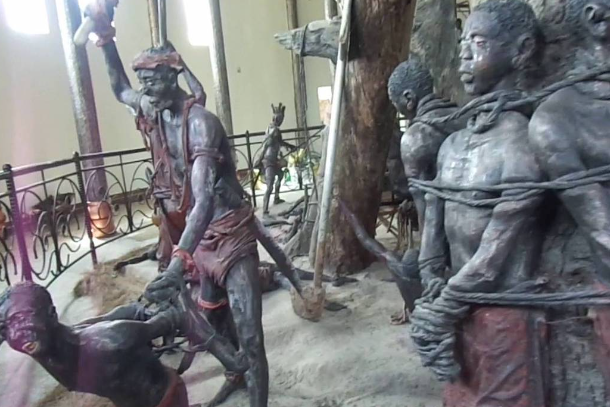
The condemned men were bound and marched approximately 40 kilometres from the royal palace at Munyonyo on the shores of Lake Victoria to Namugongo, the traditional place of execution for the Buganda Kingdom. The march took several days, during which the prisoners were treated with great cruelty. Several were killed along the route, including Andrew Kaggwa and Pontian Ngondwe, both of whom were killed before reaching Namugongo. Denis Ssebuggwawo was killed at the palace itself on the night of the arrests.
Witnesses recorded that throughout the march, the prisoners sang hymns, prayed, and encouraged one another. Their composure and faith in the face of imminent death made a profound impression on those who witnessed it, including their guards.
The Execution at Namugongo
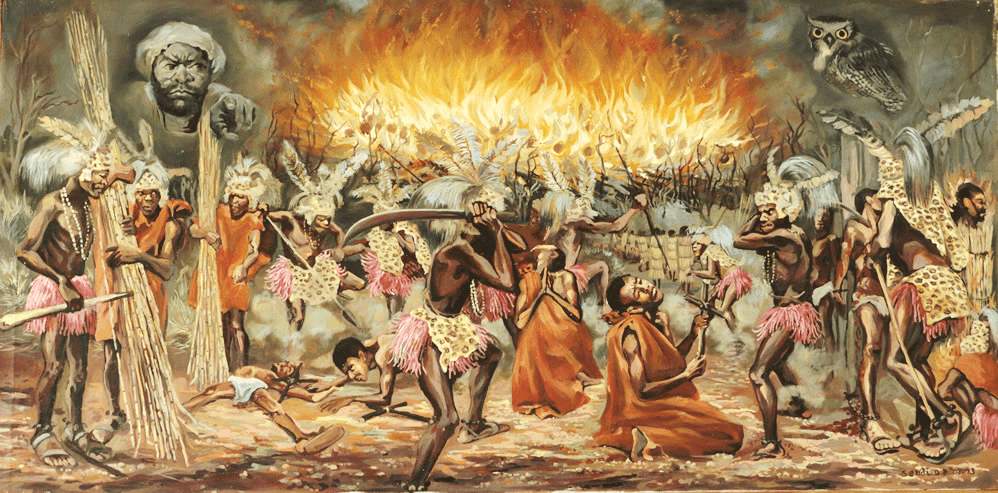
On 3rd June 1886, the principal execution took place at Namugongo. Charles Lwanga and his fellow Catholic pages were wrapped in reed mats and burned alive on a great pyre. According to accounts preserved in the oral and written traditions of the time, Charles Lwanga endured the fire with extraordinary calm, reportedly telling his executioner that he was burning him but that it was as if he were being watered with cold water. He died invoking the name of God.
The Anglican martyrs were killed separately, some beheaded, some burned, over the weeks surrounding the main execution. In total, 45 men are venerated as martyrs of Uganda: 22 Roman Catholic (canonised by Pope Paul VI in 1964) and 23 Anglican (recognised by the Church of Uganda and the Anglican Communion). The youngest among them, Kizito, was approximately 14 years old.
The breadth of those who died is remarkable. They included men of different Christian denominations, different social ranks, and different ages. What united them was their shared refusal to purchase their lives at the cost of their faith.
The Shrines: Architecture, Memory, and Sacred Space
The Roman Catholic Basilica
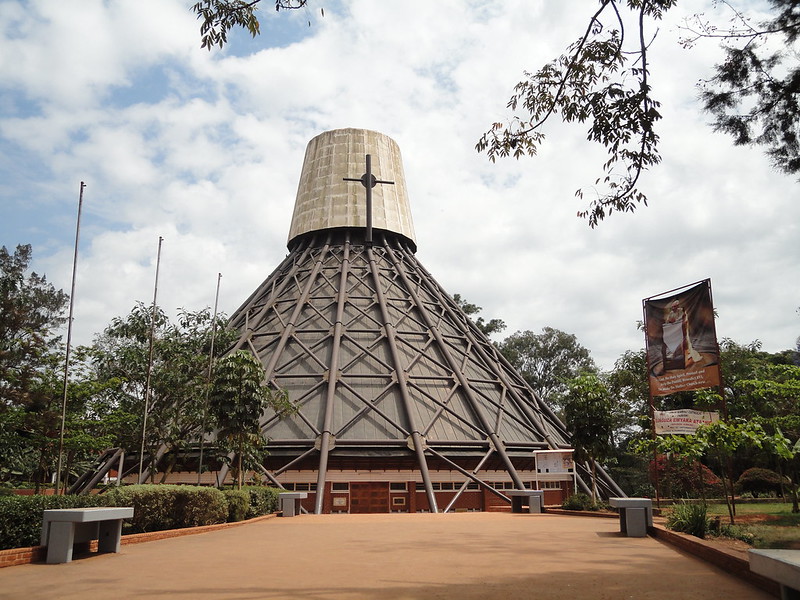
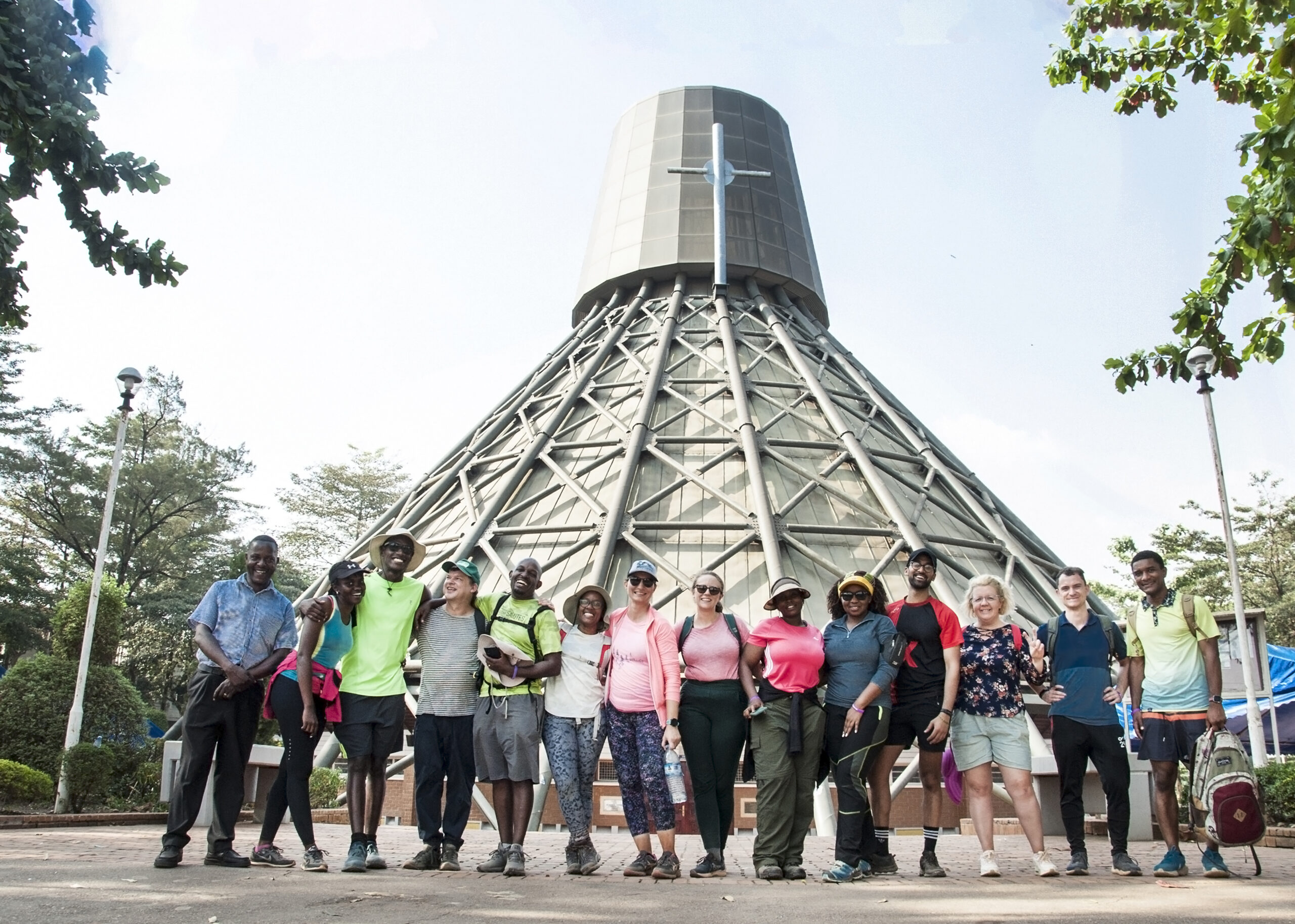
The Roman Catholic Shrine at Namugongo is dominated by a spectacular circular basilica, consecrated in 1975 and designed by the Polish architect Slawomir Odya. The building is one of the most architecturally distinctive churches in Africa, its circular form inspired by the traditional Buganda thatched hut — deliberately echoing the form of the reed enclosure in which Charles Lwanga and his companions were burned.
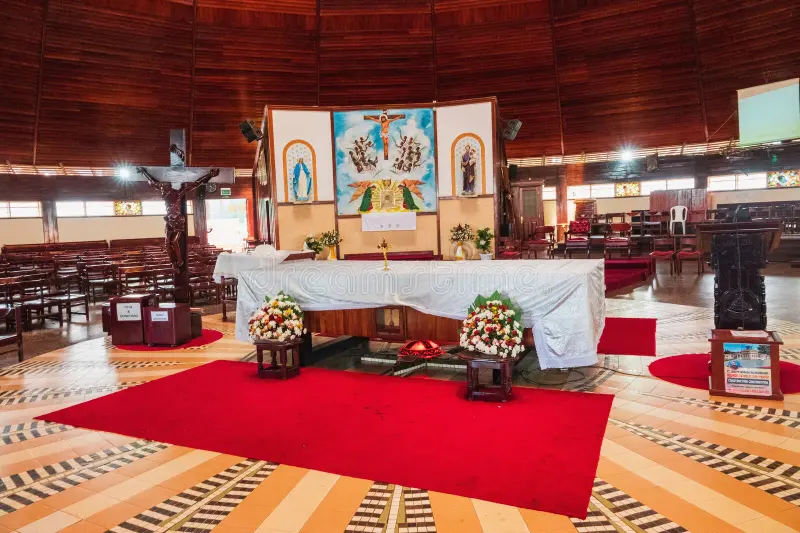
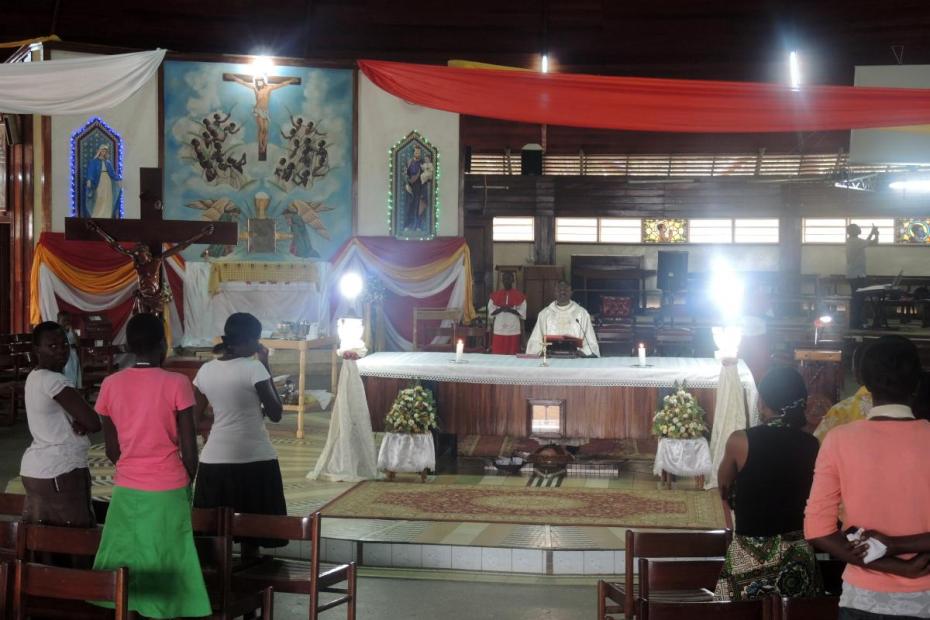
The basilica rises dramatically from its surroundings, its great concrete dome visible from considerable distance. The interior is vast and solemn, capable of accommodating thousands of worshippers, and features stained glass windows depicting scenes from the martyrdom and the broader history of the Catholic faith in Uganda. At the centre of the sanctuary, beneath the dome, the altar stands above the sacred ground where the martyrs died.
Surrounding the basilica are extensive grounds that include a large open-air arena capable of accommodating the enormous crowds that gather on the annual feast day, shrines and stations marking events in the martyrs’ story, a museum documenting the history of the martyrdom and the Uganda Catholic Church, and a perpetual flame that has burned continuously since the shrine’s establishment — a symbol of the undying witness of the martyrs.
The Anglican Shrine
The Anglican Uganda Martyrs Shrine occupies the precise site where the reed enclosure in which the martyrs were burned once stood. The Anglican shrine is more modest in scale than the Catholic basilica but no less significant in its sanctity. A traditional Buganda-style thatched structure marks the exact location of the execution, and the grounds include memorials to the individual Anglican martyrs, a church building for regular worship, and extensive gardens that create a space of quiet contemplation.
The Anglican shrine reflects the theological and architectural traditions of the Church of Uganda, which has deep roots in the East African Revival movement — a tradition that emphasises personal faith, communal confession, and a direct, unmediated relationship with the divine. The simplicity of the Anglican shrine is in many ways fitting for the memory of young men who died not for institutions but for the unadorned conviction of their hearts.
The Sacred Grove and the Spring
Within the broader Namugongo pilgrimage landscape, visitors also encounter the sacred grove of trees that has been preserved on the site, maintaining something of the atmosphere of the place as it was in 1886. A spring near the shrine is venerated by pilgrims as a source of blessed water. The combination of the grand Catholic basilica, the intimate Anglican shrine, the ancient trees, and the flowing spring creates a layered sacred landscape that speaks simultaneously of tragedy, triumph, and transcendence.
The Uganda Martyrs: Who Were They?
The 22 Roman Catholic martyrs canonised by Pope Paul VI on 18th October 1964 — making them the first martyrs of sub-Saharan Africa to be canonised in the modern era — include:
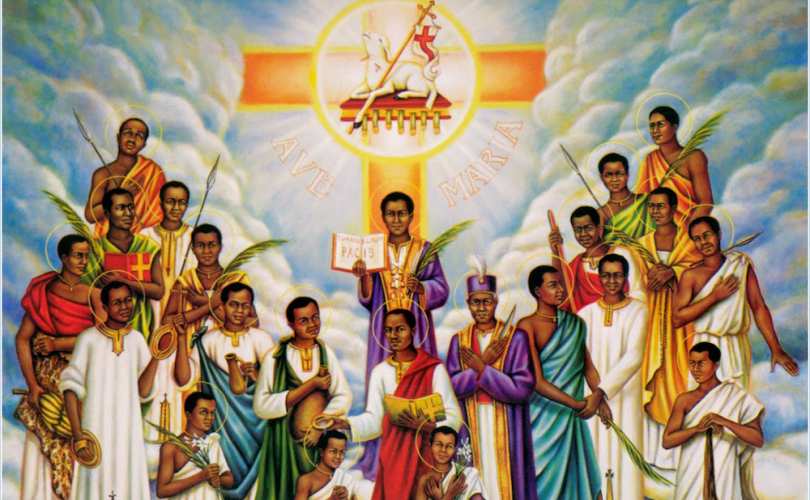
Charles Lwanga was the head of the Catholic pages at the palace and the leader of the group throughout their ordeal. Born around 1860, he was approximately 26 years old at his death. He baptised several of his fellow pages on the night of their arrest. He is venerated as the patron saint of African youth and Catholic Action in Africa.
Kizito was the youngest of the martyrs, approximately 14 years old at the time of his execution. Despite his youth, he reportedly showed no fear, laughing and joking with his companions as they were led to their deaths — not from callousness but from a faith that had transcended fear.
Matthias Kalemba (Mulumba) was an older man — a judge and sub-chief — who was killed separately from the main group, tortured over the course of several days before his death. His endurance is regarded as one of the most remarkable testimonies among all the martyrs.
Andrew Kaggwa was the chief musician at the royal court and a man of considerable social standing. His willingness to die for his faith despite having the most to lose in worldly terms made his martyrdom particularly powerful in the eyes of witnesses.
The 23 Anglican martyrs, recognised by the Church of Uganda, include men such as Alexander Kadoko, Frederick Kizito, and Robert Munyagabyanjo, whose stories, while less widely known internationally, are equally compelling testimonies of faith under pressure.
The Annual Pilgrimage: A Living Act of Faith
The Feast of the Uganda Martyrs — 3rd June
Every year on 3rd June, Namugongo becomes the destination of one of the world’s great acts of communal pilgrimage. More than three million people gather at the shrine for the Feast of the Uganda Martyrs, making it one of the largest annual religious gatherings on the African continent and among the largest Christian pilgrimages in the world.
The day is a national public holiday in Uganda, reflecting the profound place the Uganda Martyrs occupy in the national consciousness. Pilgrims arrive from across Uganda, from every other East African country, and from Catholic and Anglican communities around the world. Special delegations travel from Rome, from England, from the United States, from Asia, and from across Africa to pay their respects.
The Walking Pilgrimage
One of the most striking and moving aspects of the Namugongo pilgrimage is the tradition of walking. In the weeks leading up to 3rd June, streams of pilgrims make their way on foot along the roads leading to Namugongo, retracing — in spirit if not in exact geography — the forced march of the condemned pages from Munyonyo to the place of their execution.
Many pilgrims walk for days. Some come from as far as western Uganda, Rwanda, Democratic Republic of Congo, and Tanzania, covering hundreds of kilometres on foot. They walk in prayer, carrying crucifixes and rosaries, singing hymns, and stopping at wayside shrines to pray. The walking pilgrimages are a powerful act of embodied solidarity with the martyrs — a physical re-enactment of suffering willingly embraced in the name of faith.
Namugongo Martyrs Shrine Feast Day Celebrations
The celebrations on 3rd June itself are a magnificent spectacle of African Christianity at its most vibrant. Mass is celebrated simultaneously at both the Catholic and Anglican shrines, with the Catholic Mass typically presided over by a Cardinal or senior Vatican representative and attended by Uganda’s head of state, diplomatic corps, and representatives of every diocese in the country.
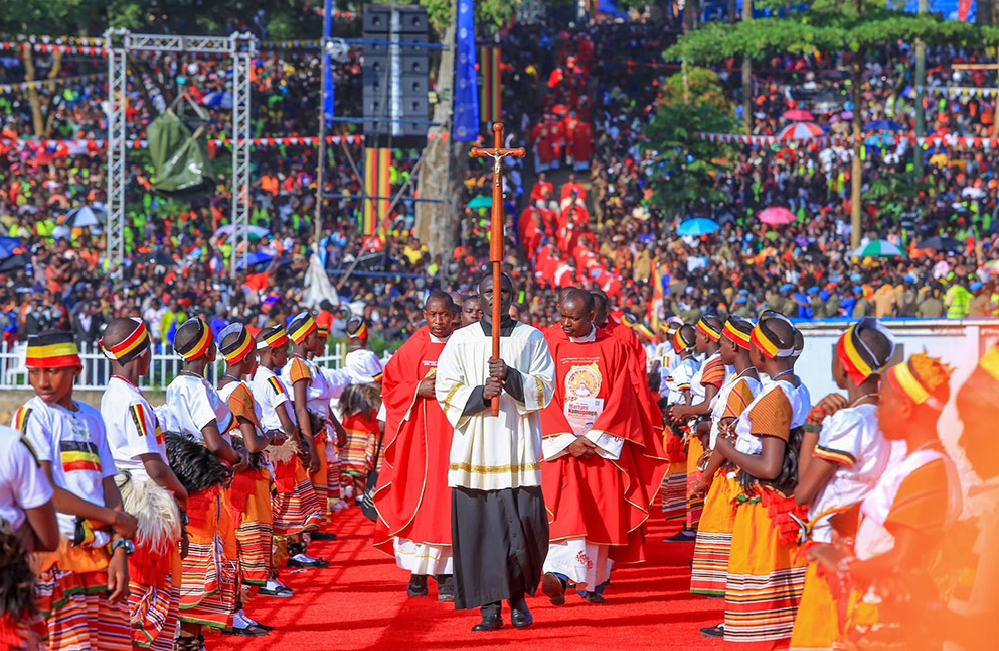
The grounds around the basilica are filled with pilgrims dressed in their finest gomesi and kanzu — the traditional formal dress of the Buganda people — alongside the bright colours of regional and diocesan pilgrim groups from across the country. Choirs sing, drums beat, and the air is filled with the sound of prayer in dozens of languages. The occasion is simultaneously deeply solemn and profoundly joyful — a combination that captures something essential about the character of African Christianity.
Historical and Global Significance
The Canonisation of 1964
The canonization of the 22 Catholic Uganda Martyrs by Pope Paul VI on 18th October 1964 was a landmark moment in the history of the Catholic Church. It was the first canonization of African martyrs in the modern era and represented a profound statement about the universality of the Catholic faith — the recognition that sainthood was not the preserve of European Christianity but belonged to the whole human family.
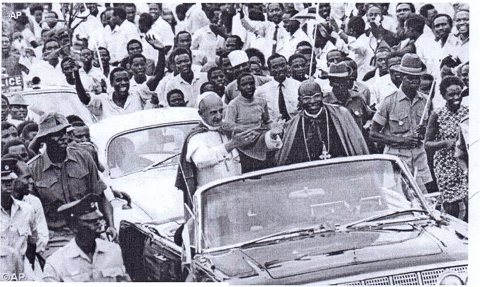 Pope Paul VI himself visited Uganda in 1969, becoming the first Pope ever to set foot on African soil. His visit to Namugongo during that trip underscored the global significance of the martyrs’ witness and cemented the shrine’s status as a site of worldwide Catholic pilgrimage.
Pope John Paul II visited Namugongo during his 1993 visit to Uganda, drawing massive crowds and again affirming the extraordinary importance of the Uganda Martyrs in the life of the universal Church. Pope Francis visited in 2015, making Namugongo one of the most visited sites by modern pontiffs outside of Rome itself.
An Ecumenical Witness
The Uganda Martyrs are remarkable in the history of Christian martyrdom for their ecumenical character. Catholic and Anglican Christians died together, on the same ground, for the same essential cause. This shared martyrdom has made Namugongo a uniquely powerful symbol of Christian unity — a place where the divisions of the Reformation mean less than the shared blood of common witness.
The joint pilgrimages to Namugongo, the cooperation between the Catholic and Anglican shrines, and the shared calendar of the feast day represent an ongoing ecumenical witness that continues to inspire Christians of every tradition. In a world where Christian denominations are often separated by centuries of mutual suspicion, Namugongo offers a vision of what unity in suffering and shared faith can look like.
Significance for African Christianity
The Uganda Martyrs hold a special place in the narrative of African Christianity. Their story challenges the colonial-era assumption that Christianity in Africa was merely an imported European religion, a tool of cultural imperialism. The martyrs were Africans who chose Christianity not because they were commanded to by colonial masters but because the faith spoke to something deep within them — and who ultimately chose death rather than renounce it.
This dimension of the martyrs’ story has made them profoundly important symbols for African Christians wrestling with questions of cultural identity, colonial history, and the authenticity of African faith. The martyrs died before the formal colonisation of Uganda. They died as subjects of an African kingdom, answering to an African king. Their witness belongs entirely and unreservedly to Africa.
The Visitor Experience
Getting to Namugongo
The Namugongo Martyrs Shrine is located approximately 12 kilometres northeast of Kampala’s city centre, along the Namugongo Road in Wakiso District. The site is easily accessible by private car or taxi from central Kampala, with the journey taking approximately 30 to 45 minutes depending on traffic. Regular matatu (shared taxi) services also operate along the Namugongo Road from the Old Taxi Park in Kampala.
Both the Catholic and Anglican shrines are open daily to visitors throughout the year, with the Catholic shrine maintaining a particularly well-organised visitor infrastructure including a car park, reception area, museum, and gift shop.
What to See and Do
A thorough visit to the Namugongo shrines will take between two and four hours and should include the Catholic Basilica and its magnificent interior, the Martyrs Museum within the Catholic shrine grounds, which houses a detailed and moving account of the martyrdom, the stations and memorials marking key events in the martyrs’ story, the Anglican Shrine and the exact site of the execution, the sacred grove and the pilgrims’ spring, and the eternal flame that burns in continuous memory of the martyrs.
Guides are available at the Catholic shrine and are highly recommended for first-time visitors, as the full depth of the site’s significance is difficult to appreciate without contextual explanation.
Cultural and Religious Protocols
Visitors to the Namugongo Martyrs Shrine are expected to dress modestly and behave with appropriate reverence. The site is an active place of worship and pilgrimage, not merely a tourist attraction. Photography is generally permitted in the grounds but should be approached with sensitivity, particularly when pilgrims are at prayer. Mass is celebrated daily at the Catholic basilica, and visitors are warmly welcome to attend.
Visiting During the Pilgrimage Season
If you have the opportunity to visit Namugongo in the days leading up to or on 3rd June itself, the experience is extraordinary. The roads leading to the shrine fill with walking pilgrims, creating a river of faith that is deeply moving to witness even for visitors with no personal religious connection to the site. Hotels and accommodation in Kampala fill up well in advance during the pilgrimage period, so advance booking is strongly advised.
For visitors who prefer a quieter, more contemplative experience, visiting outside the pilgrimage season — particularly on a weekday morning — allows for unhurried exploration of the shrines and grounds.
Combining Namugongo with Other Kampala Attractions
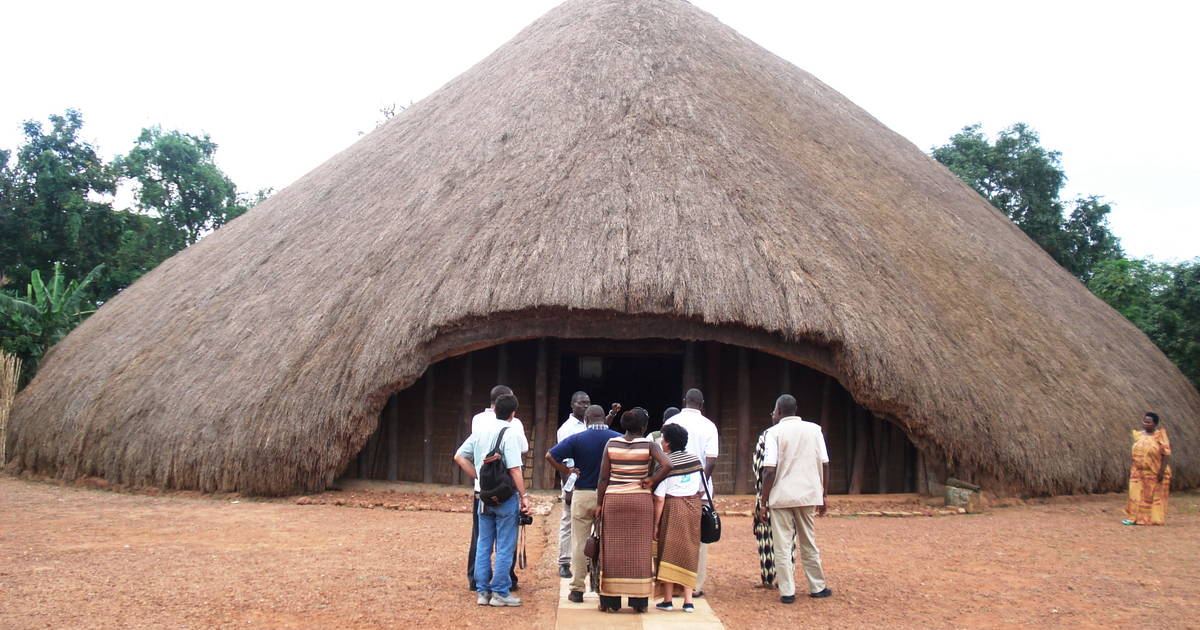
Namugongo can be combined with a range of other significant sites in and around Kampala for a rich full-day cultural itinerary. Nearby and complementary attractions include the Kasubi Tombs (UNESCO World Heritage Site and royal burial ground of the Buganda Kings), the Uganda Museum (an excellent introduction to Uganda’s diverse cultures), the Source of the Nile in Jinja (approximately one hour’s drive), the Ssezibwa Falls (a significant natural and spiritual site in Buganda tradition), and the Munyonyo Commonwealth Resort on Lake Victoria, near the site from which the martyrs began their march.
Conclusion: Where Witness Becomes Eternal
Namugongo is a place that speaks across time. The young men who died here in 1886 — teenagers and young adults, pages and functionaries, Catholics and Anglicans — could not have imagined that their deaths would become one of the great spiritual touchstones of African history. They made their choice quietly, without theatrics, with the simple and absolute conviction that some things matter more than survival.
Their witness transformed the religious landscape of Uganda. The blood of martyrs has always been called the seed of the Church, and nowhere is this more literally true than in Uganda. The faith for which the martyrs died did not wither under persecution but flourished with extraordinary vitality. Uganda today is one of the most devoutly Christian nations in Africa, and the Uganda Martyrs are at the heart of that story.
To visit Namugongo is to stand in the presence of something that cannot easily be named — a convergence of history, faith, sacrifice, and continuing devotion that reaches across a century and a half to touch something essential in the human spirit. Whether you come as a pilgrim, a scholar, or simply a curious traveller, you will not leave unchanged.
✦ Visit Namugongo Martyrs Shrine with Uganda Safari Bookings
Ready to make your pilgrimage to one of Africa’s most sacred and moving historical sites? Uganda Safari Bookings specialises in crafting meaningful, well-organised visits to the Namugongo Martyrs Shrine and the full breadth of Uganda’s remarkable cultural and natural heritage.
We offer tailor-made Kampala cultural tour experiences, pilgrimage packages for groups and individuals, multi-day Uganda safaris, and bespoke travel itineraries that pair Namugongo with Uganda’s other extraordinary destinations — from the gorillas of Bwindi to the falls of Murchison, from the Kasubi Tombs to the shores of Lake Victoria.
Our expert, locally-based team knows Uganda intimately and is passionate about connecting visitors with its history, faith, and natural wonders.
📧 Email: info@ugandasafaribookings.com 📞 Call / WhatsApp: +256-700135510

More Articles
Fort Lugard
Sezibwa Falls
Ndere Cultural Center- Traditional Music, Dance & Drama